Strong imposition of Dirichlet boundary velocities in structure-preserving discretizations of elastodynamics
Abstract
The imposition of boundary velocities in finite element models of port-Hamiltonian elastodynamics typically relies on Lagrange multipliers, yielding Differential-Algebraic Equations (DAEs). Alternatively, weak imposition methods that maintain an Ordinary Differential Equation (ODE) structure often exhibit poor accuracy at Dirichlet boundaries. To address these limitations, this paper introduces an additive kinematic decomposition at the continuous level, splitting the displacement and velocity fields into a relative dynamic component that vanishes on the boundary and a prescribed lifting function extending into the interior domain. This decomposition induces a distributed port that maps the effects of the boundary actuation inside the domain. By incorporating this mapping into suitable virtual power principles, we derive lifted port-Hamiltonian system (PHS) models that, upon finite element discretization, reduce to ODE systems in which Dirichlet boundary velocities are strongly imposed. The framework is applied to derive 2-field and 4-field formulations suited to distinct PHS geometric representations. Furthermore, we show that under specific shape functions, standard FEM schemes are recovered, demonstrating that the lifting framework in the discrete models is equivalent to the classic algebraic matrix partitioning in computational mechanics practice. The energy-balance properties and computational performance of the proposed methodology are verified through numerical simulations.
Numerical simulations
1. Geometrically exact spatial string
Simulation of the geometrically exact spatial string dynamics.
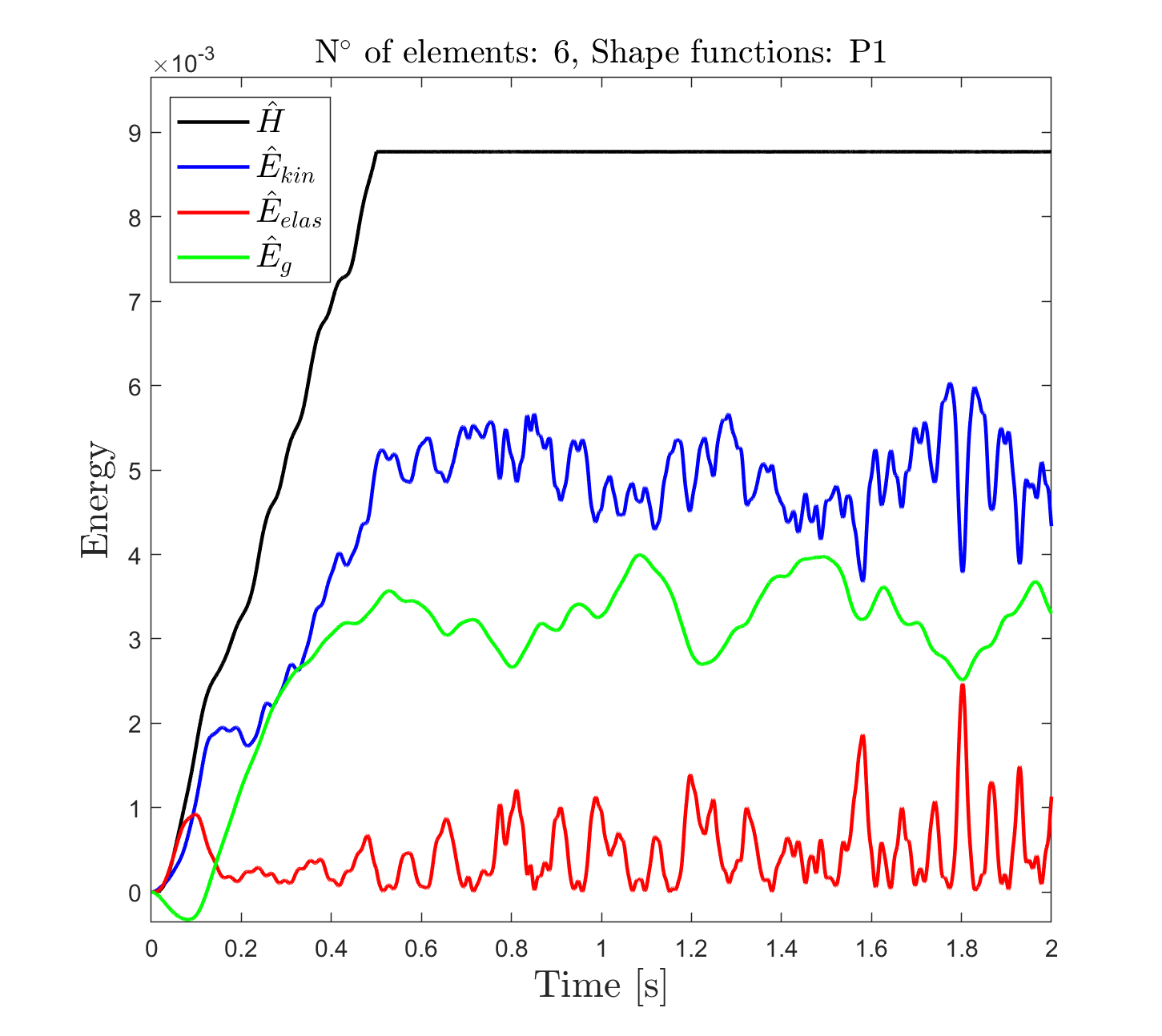
Energy evolution and balance over time.
2. Nonlinear 2D elasticity (Neo-Hookean)
Simulation of nonlinear 2D elasticity using a Neo-Hookean material.
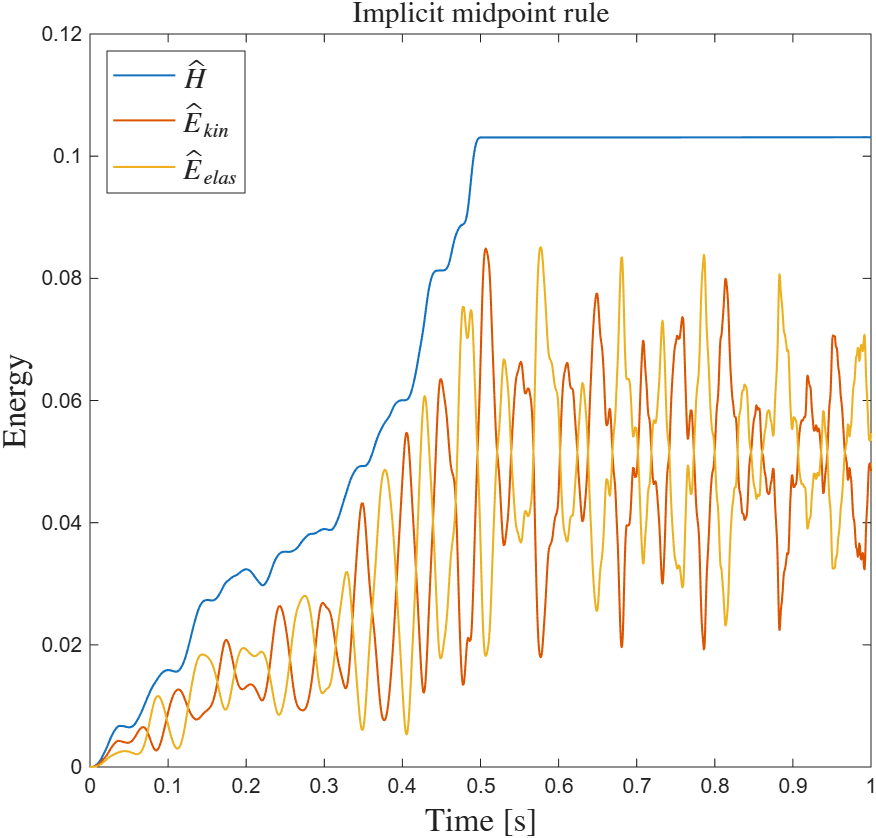
Energy evolution and balance over time.
BibTeX
@article{ponce2026strong,
  title={Strong imposition of Dirichlet boundary velocities in structure-preserving discretizations of elastodynamics},
  author={Ponce, Cristobal and Ramirez, Hector and Wu, Yongxin and Liu, Ning and Le Gorrec, Yann},
  journal={arXiv preprint arXiv:2607.26248},
  year={2026}
}
Acknowledgments
The authors acknowledge support from Chilean ANID projects: Fondecyt Postdoctorado 3260380, Fondecyt Regular 1231896, ECOS 220040, CIA250006; the French EIPHI Graduate School ANR-17-EURE-0002, the CNRS funded IRP SMARTER project; and the European MSCA Project MODCONFLEX 101073558.